
Portugal marks a new growth phase for the Medilink International Group with Gulf Med Aviation Services
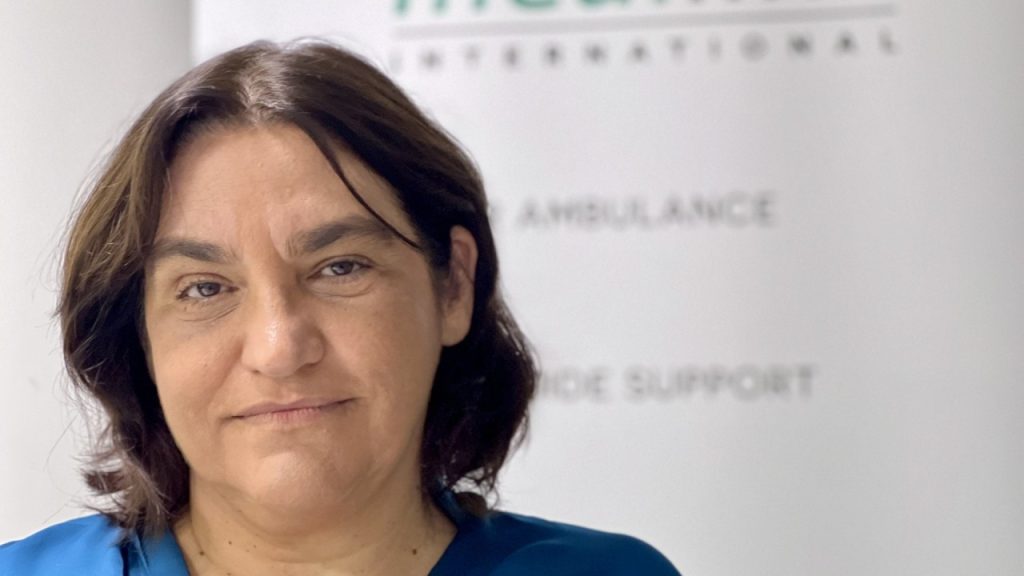
Gulf Med Aviation Services, a company within the Medilink International Group, began operations in Portugal on 1 July, providing helicopters and pilot crews for the Emergency Medical Helicopter Service (SHEM) of the National Institute of Medical Emergency (INEM). Maria Melillo, CEO of Medilink International, discusses this challenge and how this project relates to the aviation company’s growth plans within the group.
1. Gulf Med Aviation Services is now beginning operations in Portugal as part of INEM’s SHEM. What does this milestone represent for the Medilink International group?
This is truly a historic moment for our group. For more than three decades, Medilink International has been dedicated to providing healthcare in critical situations, and seeing Gulf Med Aviation Services begin operations in Portugal represents the materialisation of our vision: bringing excellence in emergency medical care to more European populations.
Portugal has a highly respected emergency medical system in Europe, and SHEM is considered the “crown jewel” of this system. Being chosen to be part of this mission is simultaneously an honour and a responsibility that we assume with total commitment.
I’m particularly pleased to report that during our first month of operations in July, Gulf Med Aviation Services helicopters ensured 86% of all transports carried out by INEM’s SHEM. Our aircraft completed 65 missions across the three operational bases.
2. What are the fundamental values that the Medilink group brings to this operation in Portugal?
Our values are deeply rooted in our genesis as a direct healthcare provider. First, safety. We never compromise safety for commercial considerations, and if we are not absolutely certain that an operation is safe, we simply will not perform it.
Second, operability. We guarantee 24/7 availability, 365 days a year, with optimised processes that minimise any downtime.
And finally, mission. Everything we do has a clear purpose: saving lives. This is not just a commercial operation for us; it is an extension of our fundamental medical mission.
3. Gulf Med distinguishes itself by having been born within a healthcare provision group. How does this origin influence the approach to aeromedical operations?
This is precisely our great differentiation in the global market. Whilst many aviation companies have diversified into the aeromedical sector, we have travelled the opposite path.
Our deep understanding of medical needs, clinical protocols and the criticality of time in medical emergencies is in our DNA. We know that we are not just transporting passengers – we are transporting human lives at critical moments.
This medical perspective influences everything, from the design of aircraft configurations to communication protocols with medical teams. It is this common language with INEM that we consider to be a fundamental added value for this partnership.
The positive feedback we’ve received from INEM’s medical teams regarding both the quality of our Airbus H135 and H145 helicopters and the collaboration with our pilots confirms that this shared understanding is already making a difference. This teamwork between Gulf Med Aviation Services and INEM is truly contributing to saving lives every day.
4. Portugal represents a strategic entry into Continental Europe. What is the group’s vision for growth in new European markets?
Portugal is a fundamental piece in our European strategy. Our location in Malta has always provided us with a central position in the Mediterranean, but Portugal opens up a new Atlantic and Iberian front for us.
We see great growth opportunities in markets where we can add real value through our unique experience. We are particularly interested in countries that value innovation in emergency medical services and where we can establish long-term partnerships with public health entities.
Our experience in Ireland and now in Portugal demonstrates that there is an important space for specialised operators who truly understand the specificities of public emergency medical services. The level of technical differentiation from a medical point of view, combined with our aeronautical capability, makes our company unique in the aviation market.
5. What are the main challenges you anticipate for this operation in Portugal and how are you preparing to overcome them?
The greatest challenge is always maintaining the standards of excellence that characterise us in a new operational reality. Each country has its geographical, regulatory and cultural specificities.
In Portugal, we are particularly focused on the training and certification of Portuguese pilots for the H145 helicopters, ensuring that we have teams that know the local reality in depth. We’re pleased to report that we already have 3 pilots certified and 15 in training, with another 3 pilots expected to begin their qualification very soon.
We are also creating a certified training organisation (ATO) to guarantee a continuous flow of qualified pilots. Our strategy always involves contributing to the local development of competencies, not just importing external solutions.
The start-up of operations in Portugal was especially complex and challenging. The entire public contracting process took place within somewhat unrealistic timings, and I say this without wanting to point the finger at anyone, as I am certain that all those involved did the best they could.
The truth is that, faced with the reality of the timings, they sought to compress into a few weeks procedures that require months to be executed in compliance with rigorous aeronautical safety standards. It was therefore necessary to find a fallback solution so that, until the public tender came into execution, Portugal could continue to have helicopters dedicated exclusively to medical emergency.
However, our operational performance has been excellent. During July, our helicopters based in Macedo de Cavaleiros were activated 27 times, those in Loulé for 25 missions, and our Évora helicopter, which began operations on 16 July, completed 13 missions. All requested missions have been executed successfully, and the interaction with medical teams has been exceptional.
6. The aeromedical services sector has been evolving rapidly. How does Medilink stay at the forefront of innovation?
Innovation for us is not just technological – it is also operational and human. Yes, we invest in state-of-the-art aircraft such as the H145, which represent the state of the art in aeromedical helicopters.
In addition to the two H145s already in operation, we have two more in advanced preparation stages, ensuring our complete fleet of four aircraft as stipulated in the contract.
But we also innovate in processes, team training, and operational data management. Our network and international experience allow us to share best practices between different markets and adapt innovative solutions to local specificities.
7. What message would you like to leave about Medilink International’s commitment to the success of this operation in Portugal?
I want to be very clear: we have not come to Portugal just to fulfil a contract. We have come to build a long-term partnership that genuinely benefits the Portuguese population.
Our commitment goes beyond mere service provision. We want to contribute to permanently raising the standard of excellence of SHEM and leave a positive legacy in the Portuguese aeronautical sector.
This commitment is demonstrated by our significant investment, approximately €5 million committed to ensure the start-up and continuity of operations. In addition, the aircraft dedicated to this operation, represents a global investment of around 45 million euros.
We are investing in local capabilities, training, and knowledge transfer. Our proposal represented significant savings for the Portuguese State without any compromise on quality, and we intend to demonstrate every day that this trust has been well placed.
Portugal is not just another market for us. It is an extension of our Medilink family.

