
Helicopters in the air. Lives depending on it.
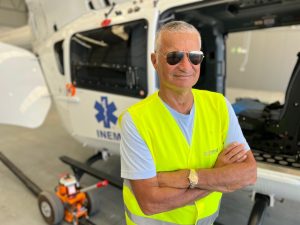
Flying conditions were perfect, with good visibility and virtually no wind. In around ten minutes, the Airbus H135 completed the crossing between the island of Gozo and the main island of Malta.
“Even when the weather is on our side, in a HEMS flight there is another factor that can sometimes be a source of tension: the condition of the patient on board, particularly in situations where their life is at risk”, says Marcus Kluger, the aircraft’s commander. In this case, the patient was a gentleman close to 60 years of age, seriously injured in a road accident, and the transfer between medical facilities went without any complications, under the close watch of the medical team also on board.
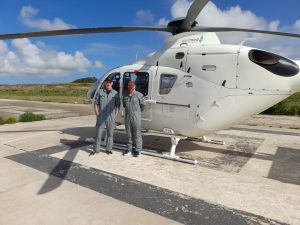
This was one more emergency mission completed by Gulf Med Aviation Services. “For a HEMS pilot, a successfully completed mission means we had a positive impact on someone’s life, and that is deeply rewarding”, says Marcus, a German national who has been with the company for ten years.
Leaving Malta, we head south to Europe’s Iberian Peninsula, more specifically to Portugal’s Algarve region. One of the four brand-new Airbus H145s that Gulf Med Aviation Services operates in that country was carrying out another mission, this one in Faro, responding to a victim of sudden illness with a critical cardiac episode.
The transfer of this 78-year-old woman was ultimately made to the country’s largest hospital, in Lisbon, Portugal’s capital, roughly 240 kilometres from where the incident occurred. “No matter how much experience we have, flying with a critically ill patient on board carries an added layer of responsibility compared to other types of missions, in the sense that we must ensure, before accepting the mission, that we have the conditions to see it through”, says Pedro Carriço, the pilot commanding the crew on this flight.
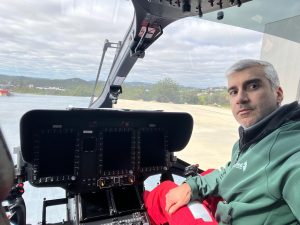
With 21 years of experience on cockpits and 7 of those in HEMS missions, time plays a crucial role in the work of these professionals. “That is why our response in Portugal is designed so that within minutes of activation the helicopter is already airborne, to reach those who need assistance as quickly as possible”, concludes this Portuguese pilot.
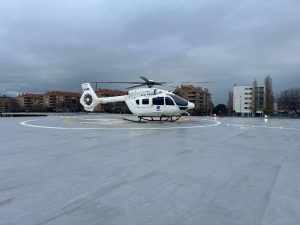
That day, at the same time, the other three H145s serving the National Institute of Medical Emergency (INEM) in Portugal were also engaged in HEMS missions. In other words, all four helicopters that Gulf Med Aviation Services permanently operates in Portugal were simultaneously in the air, a statistical improbability, but a very concrete reality on that April afternoon, the exact date of which we have omitted to protect the identity of the patients involved.
Gulf Med Aviation Services: a company with a medical DNA
“Helicopters are complex machines. But they are instrumental, because we know that it is through them, and through the professionalism of our pilots, that we are able to make a decisive contribution and a positive difference in the lives of many communities”, says Simon J. Camilleri, CEO of Gulf Med Aviation Services. Headquartered in Malta, this company within the Medilink International Group was born with a medical DNA.
“That makes all the difference. Our background in healthcare gives us a deep understanding of the very particular characteristics of HEMS flights”, says the man who founded Medilink International 32 years ago and Gulf Med Aviation Services ten years ago. “And this understanding is not corporate talk, it materialises in our complete focus on the mission, on operational safety, and on having the best pilot teams”, concludes Simon J. Camilleri.
Pilot Carsten Zillgen was one of two pilots in the cockpit of the helicopter based in central Portugal, in Viseu, which that afternoon was dispatched to respond to a road accident in the small municipality of Penamacor. This primary mission allowed the medical team to assist a 33-year-old man, who was subsequently transferred by road, already stabilised, to a healthcare facility.
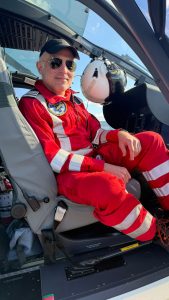
“Long before a mission even begins, there is a great deal of teamwork behind the scenes, from planning to maintenance, that makes it possible for the helicopter to lift off,” says the German pilot, who brings 35 years of flying experience and five years on the H145, adding that “in the cockpit, there is a strong dynamic between pilot and co-pilot, built on trust, that allows us to carry out each mission to the highest safety standards.” However, “teamwork and trust is by no means limited to the cockpit. It extends to the HEMS medical crew and, beyond that, to all emergency responders on scene: from police officers to firefighters and ambulance crews, right through to the very first person providing initial assistance.”, he adds.
Safety remains one of Gulf Med Aviation Services’ core values. The helicopters currently in operation in Portugal further enhance operational safety, with Carsten Zillgen emphasising that the H145 is “a new-generation aircraft with a highly advanced electronic support system, making it an exceptionally capable platform for HEMS operations.”
This view is shared by pilot Rodrigo Sá, the duty commander on the helicopter based in Évora, who also emphasises the “great versatility these helicopters offer in emergency medical missions, allowing landing in virtually any location.” It was at the scene of a road accident in the Setúbal region that the pilot landed the aircraft he was commanding that day, enabling the team to assist a 68-year-old male victim, who was subsequently airlifted to a hospital in Lisbon.
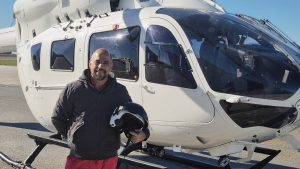
That helicopter completed three missions on that particular day. “But behind the numbers there are real people, with names, with families, people we helped at a particularly difficult moment in their lives, and that is what makes this work truly unique and fulfilling”, says this Portuguese pilot.
That leaves the helicopter based in Macedo de Cavaleiros, in northern Portugal. In what was its second mission out of three that day, it was activated to respond to a road accident that had occurred relatively close to where it had stopped to refuel, some 360 kilometres from its base. It was a difficult day on Portuguese roads, as the road accident statistics for that day bear out, and the victim of this accident did not survive.
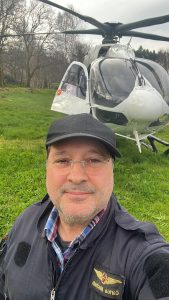
“Situations where there is a tragic outcome for the victim always have an impact on the pilots too. Even so, it is always worth that extra effort to ensure that person received the best possible care”, says Carlos Machado, the pilot commanding the crew on board that aircraft. With 35 years at the controls of helicopters, he has had time enough to know that “we build up defences that allow us to manage the emotional weight of these incidents.”
And then what? The answer comes quickly: “straight away the focus shifts to the next mission. When we receive a new activation, we feel once again that our work is meaningful, and we want to get to the scene as fast as possible so the medical teams can do their job”, says this experienced Portuguese pilot.
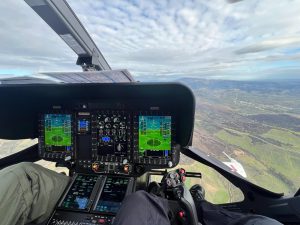
And so it is, because the emergency medical helicopters of Gulf Med Aviation Services are an undeniable asset to the healthcare systems of the countries in which they operate. That same day, in Ireland, another of the company’s H135s was on full standby, ready to lift off at the first call, as it is every day.
For a company accustomed to operating in an area where the thinnest of lines holds life together, there is no day that can be called perfect. But on this April day, when our pilots and an entire vast support team gave so much of themselves, a strong feeling lingered in the air: mission accomplished.

