
3 questions for… Chris Keatin
27/11/2025
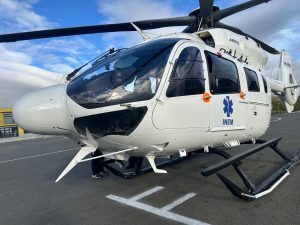
The Helicopter Emergency Medical Service (HEMS) of INEM in Portugal began a new chapter in early November, with Gulf Med Aviation Services providing four Airbus H145 helicopters operational 24 hours a day. To better understand the challenges of crew training and certification that made this project possible, we spoke with Chris Keating, Flight Operations and Crew Training Manager at Gulf Med Aviation Services.
Chris, as Flight Operations & Crew Training Manager, what was the biggest challenge in preparing the crews for this operation in Portugal?
The significant challenge was undoubtedly the time factor versus non-negotiable regulatory requirements. When we took on this project, we knew we would have to certify 36 pilots for the Airbus H145. And we would have to do so without any compromise on the safety and quality standards that European regulations demand and our own internal, safety and operational standards. In respect of these regulations, the entire Gulf Med Aviation Services Training, Operations, Maintenance and Management team fully understand and respect the regulations as the cornerstone of safety.
We are fortunate that our Financial and Human Resources teams understand the requirement to comply with the regulations and provide proactive and positive support to our efforts to achieve that compliance. At the head of this team sits our Accountable Manager/Managing Director. His support and understanding when the challenges stacked up was paramount to the success of the program.
The pilot certification process to place a new aircraft type onto their Aviation License is comprehensive and thorough. Added to this is the requirement to convert the pilots to the new operation in respect of Procedures, Processes, Paperwork, Records, Crew Resource Management, and our Gulf Med Aviation Services Company Culture. Holistically, the process is about learning how to operate a new type of helicopter, in a new environment under a new set of operational procedures. Together this forms the core of the Operator’s Conversion Course.
For the new H145 Helicopter at the end of their Type Training, the pilot is competency checked in the aircraft systems, normal and emergency procedures, operational capabilities and limitations, performance, navigation, communications, and H145-specific manoeuvres. Once delivered to the flight line, the Pilot operates under the supervision of a Line Training Captain until they are have achieved competence in operating their new helicopter in the challenging HEMS environment. By mutual agreement, Line Training Captain happy, Candidate Pilot happy and competent, a final Line Check is performed and recorded. For each individual candidate pilot the journey form the start of training to the Line check at the end, is different and whilst the core regulatory minimums must be respected, training has often been tailored and flexible to meet the individuals experience, background as they progressed through training sausage machine. The dedication, skill and experience of the Gulf Med Aviation Services Training Captains key to this process.
One of the more subtle challenges we faced is whilst a pilot is undergoing certification for a new helicopter type, aeronautical regulations stipulate that they must be exclusively assigned to that helicopter type until they have achieved at least 50 flight hours on the new type. This required meticulous planning across all our operational geographies.
Each pilot candidate completed approximately 60 hours of theoretical training and up to 30 hours of flight time – both day and night with our partner ATO (Approved Training Organisation) in the south of France. The process took between 4-8 weeks per pilot. When you multiply this by 36 pilots, you can understand the scale of the logistical and operational challenge.
With 33 pilots certified for the H145 and 3 more in training, how do you ensure that all maintain the highest operational standards, especially in a HEMS operation which is notoriously demanding?
The Gulf Med Aviation Services culture considers that Compliance with the Regulations is the cornerstone of Flight Safety. Initial certification is just the beginning. However, as an experienced HEMS Operator, the company maintains its commitment to continuous training and constant improvement. We already had a robust and comprehensive training system that exceeds by some margin, the minimum regulatory requirements in place for our existing operations.
For the Portugal Operation we were able to draw on this experience, fine tune it specifically for Portuguese operational requirements, and deploy a training program that has proven highly effective. Like I said earlier, this was a collaborative team effort that required at times comprehensive co-ordination across all the Gulf Med Aviation Services departments. In addition, the support we received from our Parent Organisation Medilink International, in respect of financial control, human resources and competent leadership at the senior levels made this training program a success.
Safety and the Maintenance of Operational Standards require visionary thinking at both the Strategic and Tactical levels. I feel very confident in team from top to bottom and that is borne from the unswerving support the Training Department and this process has received from the teams in Gulf Med Aviation Services and Medilink International. Perhaps equally important is that we have put in place a Strategic and Tactical management team that believes in empowerment down to the very lowest levels of the operational structure. The individual pilot or engineer is capable and confident of making the right decision at the right moment, including when safety of standards are about to be compromised, saying No!
Nevertheless, as we always say in HEMS, we are only as good as our last mission! The bedrock of training, operational processes and procedures gives me the confidence that the standards we have thus far set will continue to build amongst the team. For HEMS operations in Portugal, this is particularly important. We’re talking about missions that may involve landings in confined locations, rapidly changing weather conditions, for example.
Fatigue and social conditions are a high priority for us. We try to operate under two principles: the first, we never want to place a member of our staff in or near a helicopter when they are fatigued; the second we want to put a member of our staff in a location they do not want to be.
Specifically on the subject of fatigue, of course we are obliged by the regulations to implement a Flight Time and Duty Limitations scheme (FTL). However, the objective nature of these schemes can never fully comprehend and cater for the complexities of the HEMS operation. Multiple missions occurring in a short space of time. Sometimes towards the end of the pilot’s roster period. So, to ensure we can maintain our principles, we have implemented an addition Fatigue and Stress Recording System (FASR).
This system is entirely subjective on the part of the individual crewmember and is empowered to suspend the pilot or engineer temporarily should the operating conditions contrive to provoke stress and fatigue to an unsafe level. As far as I am aware, Gulf Med Aviation Services is the only Operator worldwide that has implemented this important subjective safety backstop system to support the objective nature of the FTL scheme.
Looking back on these intense months of preparation, and looking to the future, what is your vision for the development of piloting skills in Portugal?
The program of training for the Portugal pilots has been comprehensive and thorough. We planned strategically for the process, establishing early partnerships with the Simulator Providers and the Approved Training Organisations to ensure the highest training standards. Coordinating the certification of 36 new pilots, in parallel with the operational preparation of four bases, whilst maintaining our commitments in Portugal and other countries, was a team effort involving not only the Training department but Finance, Maintenance, Continued Airworthiness and the Flight Operations Management team. Gulf Med Aviation Services have demonstrated considerable ability to deal with complex and ever-changing situations with always a single eye on the objective. That to provide well trained, safe, and experienced flight crew to the Portugal HEMS Operation.
What has been achieved thus far is only the beginning. It is up to us now to build at every level as our in-Country experience grows to ensure we are able to provide a world class HEMS service for the people of Portugal. Having been through this comprehensive process, the team has demonstrated exceptional capability and professionalism at every level. This gives me confidence that with the proven support of the Gulf Med Aviation Services and Medilink International teams, our mandate from the Accountable Manager, to provide a safe, reactive, and efficient HEMS operation for Portugal will continue to be met and improved for the future.
About Chris Keating
Chris Keating is Flight Operations & Crew Training Manager at Gulf Med Aviation Services, where he is responsible for flight operations management and ongoing training of all crews. With extensive experience in commercial aviation and HEMS operations, Chris leads certification processes, training and maintenance of operational standards across all geographies where Gulf Med Aviation Services operates.

