
Building Capability, Not Just Capacity by Dr. Nuno Cosmelli
At Medilink International Training Academy, our objective is not simply to train more people. It is to make our doctors, nurses and paramedics more capable, more confident and more prepared when something goes wrong in the complex environments they operate in.
What is the difference between capacity and capability?
Capacity is having 12 healthcare professionals in a room completing a course. Capability is knowing that when a real cardiac arrest, major trauma or mass-casualty incident occurs, those professionals can work together and manage it safely, improving survival rates.
The certificate is important, particularly in internationally certified programmes such as BLS, ACLS and PHTLS, but the certificate alone does not save a patient; the person holding it does.
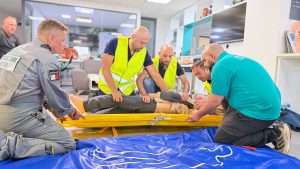
Why does training need to go beyond certification?
Through Medilink Academies, we deliver certified programmes such as BLS, ACLS and PHTLS, alongside courses in difficult airway management, mass-casualty management and aeromedical transport in fixed-wing and rotary-wing environments, because real patients do not follow PowerPoint presentations.
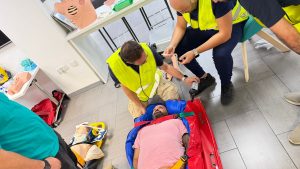
Our philosophy is simple: play, practise, make mistakes, learn and repeat. We want our doctors, nurses and paramedics to have fun during training, even when the scenario in front of them is very serious. Simulation creates a safe environment where teams can make mistakes without harming anyone and, more importantly, learn how not to make those mistakes when the patient is real.
Does everyone pass?
No, and that is important. Attendance is not the same as competence, and certification should never become a participation trophy. For our certified courses, candidates must meet the required theoretical and practical standards. When someone does not reach those standards, we identify the gaps, provide feedback, practise again and reassess. The objective is not to fail people, but to make sure they are ready.
How does training build confidence?
By making the abnormal feel familiar. A cardiac arrest, difficult airway, major trauma, helicopter evacuation or mass-casualty incident can be stressful, even for experienced clinicians.
Repeated, realistic simulation helps clinicians develop clinical reasoning, communication, leadership and muscle memory. We deliberately add lots of pressure, noise, limited resources and unexpected changes, and most of the mannequins are very uncooperative patients!
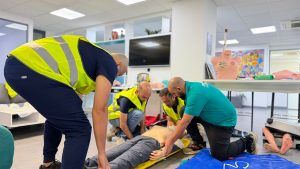
When clinicians have already managed a difficult scenario several times in training, the real emergency is no longer completely unfamiliar.
Can the same training model work everywhere?
The clinical principles may be international, but the operational reality is local.
Training in Malta, Angola, Algeria, Guinea and Oman cannot simply be copied and pasted. Available equipment, evacuation times, team composition, language, local healthcare systems and access to definitive care are different, and our instructors therefore adapt scenarios to the environment where clinicians actually work. There is little value in training someone to use equipment or resources that will not exist when the emergency happens.
What have I learned from delivering training internationally?
The most successful courses are not necessarily those with the most slides; they are the ones where people are moving, thinking, communicating, making decisions and occasionally arguing with the mannequin.
Simulation and Megacodes also reveal things that a written examination cannot: leadership, teamwork, closed-loop communication, situational awareness and the ability to remain functional under pressure.
Why are local instructors so important?
Our goal is to develop local instructors and strong clinical teams who can continue practising, running simulations and sharing knowledge after the Academy faculty has left. That is when training becomes part of the clinical culture rather than an annual, isolated event.
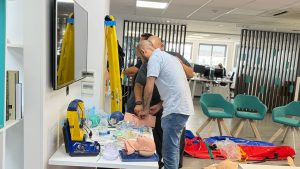
What does success look like?
Success is not simply the number of certificates issued. It is seeing a clinician recognise deterioration earlier. It is watching, as a topside team, run a resuscitation with clear leadership and communication. It is seeing the correct equipment prepared before it is urgently needed. And it is knowing that someone who struggled during training practised, improved and demonstrated competence in real cases.
Most importantly, success is when an emergency happens and the team responds almost instinctively because they have been there before in simulation.
Our Training Academies continue to grow in 2026, strengthening clinical capability, confidence and emergency preparedness across our international operations.
So far, 153 courses have been delivered across six countries: Guinea, Angola, Algeria, Malta, Libya and Mozambique. Guinea leads the programme with 108 courses, followed by Angola with 17 and Algeria with 15. June was our busiest month, with 29 courses delivered.
Of all training delivered, 32 courses (20.9%) were internationally certified programmes, including BLS, ACLS, PHTLS and Aeromedical Training, while 121 courses (79.1%) were internal IHS programmes.
But numbers only tell part of the story.
Our 2026 records represent 1,266 participant attendances, with a success rate above 95%.
Participant satisfaction reached approximately 90.3%, and, perhaps most importantly, 100% of participants said they would recommend our courses to their colleagues.
That is what Medilink International Training Academy aims to build. Not just capacity. Capability. Not just certificates. Readiness. Because in emergency medicine, we should never train believing, “This probably won’t happen.” It is not a question of if… It is a question of when it is going to happen, and when it happens, our teams need to be ready.
So, what are you waiting for?

